Brand Partnerships · 6 October 2026
Beyond the Ambassador: What Mbappé × Loewe Tells Us About Partnership Depth
Kylian Mbappé went from Loewe ambassador to shareholder. The relationship reveals an interesting distinction between commercial alignment and cultural expression.
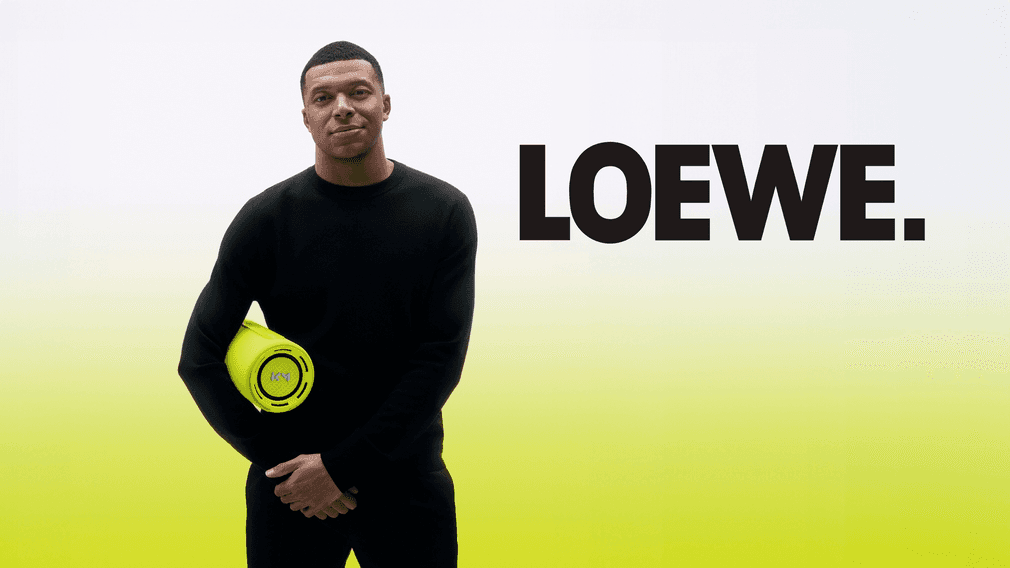
Kylian Mbappé doesn't just advertise Loewe. He owns part of it.
In December 2023, he became the German technology company's first global brand ambassador. Less than a year later, his investment company, Coalition Capital, acquired a minority stake in Loewe — reportedly in the double-digit percentage range.
That makes this more than a conventional celebrity endorsement.
On paper, it creates something brands spend years trying to manufacture: genuine alignment between the success of the partner and the success of the business.
Which makes the way the relationship has developed worth examining.
01
Why Mbappé made sense
Loewe's challenge was bigger than selling televisions.
The almost century-old company was expanding into audio and other premium technology categories while seeking a stronger international position and a younger generation of consumers.
Mbappé offered access to exactly that.
He is one of the world's most recognisable athletes, with a social audience exceeding 100 million people on Instagram alone. Around the time of his investment, Loewe was also speaking publicly about significant growth ambitions, new product categories and the role Mbappé's international profile could play in that expansion.
The strategic logic is clear.
But access to attention and the ability to convert that attention into relevance are two different things.
2023
Ambassador
2024
Investor
2025–26
Activation
02
From ambassador to owner
Loewe has activated the relationship.
The We. HEAR Pro portable speaker was introduced as the first product to emerge from the collaboration. Mbappé has since appeared across the company's audio communication, fronted the launch of Loewe's Leo headphones alongside David Guetta and, more recently, appeared in the campaign for its Antares television range.
There is clearly activity. But much of the public-facing expression remains familiar: Mbappé, the product, premium imagery and the language of performance and excellence.
There is nothing inherently wrong with that. What makes it interesting is what sits underneath.
Mbappé isn't simply Loewe's ambassador. He has a financial interest in the company succeeding.
The commercial relationship has become unusually deep.
Has the cultural expression of that relationship deepened at the same rate?
This is what makes Mbappé × Loewe interesting. The underlying relationship is difficult to replicate: one of the world's most recognisable athletes hasn't simply agreed to promote a heritage technology company. He has invested in its future.
Yet much of what consumers see publicly still resembles the familiar language of celebrity endorsement.
There may be significantly more happening behind the scenes. Public information cannot tell us the full commercial impact of the relationship or how much revenue, audience growth or brand value can be attributed to Mbappé.
But the contrast between the depth of the relationship and the distinctiveness of its public expression is worth examining.
03
The partner is not the strategy
Brands spend enormous amounts of time deciding who they should work with.
Who has the audience? Who has credibility? Who generates attention? Who fits the brand?
All are necessary questions. But partnership strategy should go further.
The strategic question
“What becomes possible because these particular two parties chose each other?”
If the public expression of a partnership could be recreated with several other famous people simply by changing the name and photography, there is reason to ask whether its distinctive potential is fully visible.
That doesn't mean the partnership isn't commercially successful. Nor does it mean the partner was wrongly chosen.
Mbappé may ultimately prove to be an excellent investment for Loewe. The information available publicly today isn't enough to make that judgement.
But the relationship highlights a broader point. Brands are increasingly seeking deeper relationships with talent — from long-term ambassadorships and creative collaborations to equity and ownership.
Deeper commercial alignment does not automatically produce deeper cultural relevance.That still has to be built.
Ultimately, the opportunity in a partnership isn't defined by how famous the partner is — or even by how much of the company they own. It is defined by what becomes possible because those two parties chose each other.
ni-comms Insights
Perspectives on strategic partnerships, culture and long-term brand relevance.
Explore more Insights